Asia is one of the significant trading regions of the global marketplace, supported by the consumer market, strong manufacturing capabilities, and expanding supply chains. The region is maintained with connectivity across major production and consumption centres across East Asia, South Asia, Southeast Asia, Central Asia, and the Middle East. China, India, Japan, South Korea, Vietnam, Indonesia, and Thailand are the top trade partners, and the collaborative traders with Central Asia and the Middle East. Asia Customs Data provides detailed visibility into the movement of products across international borders.
The latest information available gives a clear understanding of import and export activities for progressive traders. Businesses can use the reliable information on Asia import customs data to gain an understanding of the different Asian economies, trade, and the development of strategies for sourcing, sales distribution, and market expansion. Asia Import Export Data is also considered a boon for the authorities trying to be progressive because it provides them with a broader view of regional trade flows and helps them evaluate historical and current commercial activity.
THE SIGNIFICANT ROLE OF ASIA IN GLOBAL TRADE
Asia has been maintaining a central position in global trade. The overall growth rate and the nation’s ranking are due to the large population, growing middle class, technological development, and the maritime and land-based trade routes. The region is concentrated among the largest exporters and importers that have been continuously serving as an important sourcing destination for international companies. The manufacturing ecosystem is one of the strongest contributors to Asian trade. Electronics, electrical machinery, automobiles, machinery, textiles, and pharmaceuticals are the massive contributors throughout the regional integration. Asia trade data enables businesses to get commercial movements of trade at the product and country level.
The companies can examine the countries with active participation in particular trade flows to understand the relationship between suppliers, buyers, manufacturers, and distributors. The region benefits from extensive regional trade agreements like ASEAN and bilateral trade arrangements, strengthening cross-border commerce. Businesses can use the Asia Customs data for evaluation of the individual countries and the broader regional opportunities. The information supports market entry planning with competitor monitoring and sourcing decisions.
THE COMPREHENSIVE OVERVIEW OF ASIA IMPORTS
Asia import customs data provides a detailed overview to businesses regarding the latest resource essentials of the economy: raw materials, intermediate products, machinery, energy resources, and consumer goods are the top variants. The composition of imports mainly varies between countries depending on industrial capacity, domestic consumption, natural resource availability, and infrastructure requirements. Asia import customs data helps businesses examine products with relevant entries in the individual markets.
Machinery and mechanical equipment, along with electrical and electronic products, have been massive contributors to the pharmaceutical products, metals, food products, vehicles, and industrial components sourcing of the Asian continent. The manufacturing sector is responsible for creating substantial demand for intermediate goods. The frequent import of components, mainly raw materials, machinery, and industrial inputs, is maintaining the assembly into finished products for international markets. The companies can use the Asia import-export trade data for examination of the purchasing behaviour of businesses with particular product categories.
THE EXPORT MARKET OVERVIEW OF ASIA
Asia trade data gives a detailed overview of the latest traded variants of the economy. The export portfolio is mainly concentrated in electronics, machinery, vehicles, textiles, apparel, chemicals, pharmaceuticals, metals, petroleum products, agricultural commodities, and furniture. The Southeast Asian economies and the East Asian economies are maintaining collaborative trade with integrity according to the manufacturing ecosystem. Electronics and electrical products are moving through several countries for different stages of production.
Asia export data provides detailed visibility to businesses regarding Asian markets and their effective trade with destinations purchasing those products. Exporters can use the information for identification of potential countries and for expansion of the markets where the demand is specifically increasing. The data assists manufacturers and distributors in understanding the competitive suppliers. The study of the export activities within the product category helps the businesses with evaluation of destination market shipment patterns and pricing trends. The geographical diversity strengthens the export opportunities. The countries in the regional supply chain maintain integrity with Europe, Africa, the Middle East, Latin America, and other Asian markets.
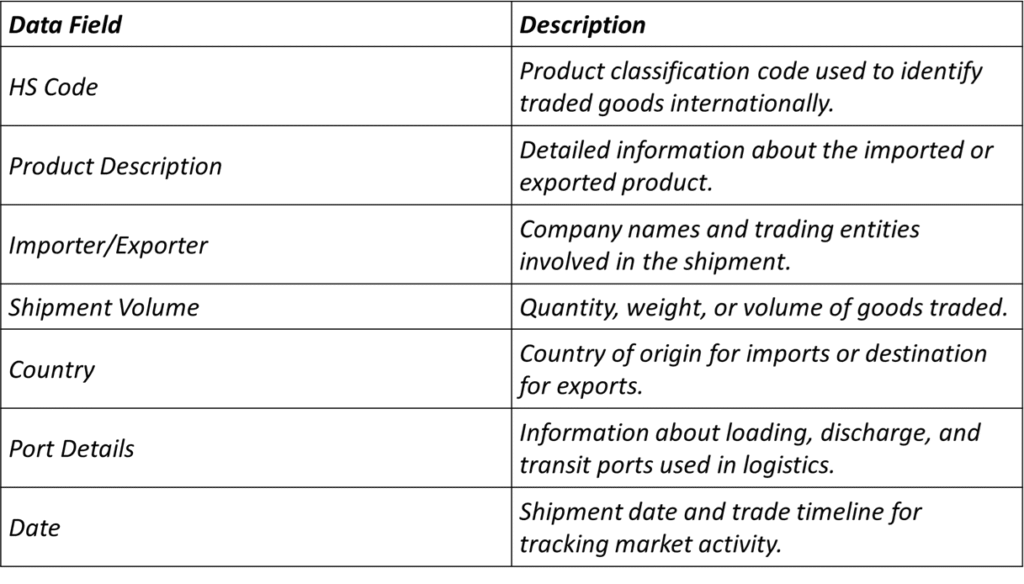
WHAT DETAILS ARE INCLUDED IN ASIA CUSTOMS DATA?
THE EFFECTIVENESS OF ASIA IMPORT DATA AND ASIA CUSTOMS DATA IN BUSINESS GROWTH
Asia import data and Asia Customs data are considered valuable tools for businesses looking for service expansion. The companies can properly identify the businesses for repeated acknowledgement of particular products, while prioritizing the potential prospect. The approach helps the marketing leads get an overview of entire market strategies with direction. The progressive companies can use the product-level information to focus more on sales and activities on relevant buyers.
Asia import-export trade data supports competitor monitoring. Traders can even examine the suppliers’ activities with product category and a proper understanding of the companies’ sourcing essentials. The supply chain analysis is also considered important because it helps the businesses compare the supplier countries while identifying alternative procurement markets.
HOW DOES ASIA IMPORT-EXPORT DATA SUPPORT BUSINESS GROWTH?
- Identification of buyers and suppliers – Asia import-export data helps businesses get proper clarification on the potential importers, exporters, distributors, and suppliers. The product description promotes the acknowledgement of the businesses regarding the prospecting activities as per the specific products and markets.
- Competitor shipment monitoring – The Asia shipment data gives proper evaluation of competitor purchasing and selling activities to the businesses. The traders can examine the suppliers and the destination markets in association with the specific products and develop strategies for improvement of trade.
- Market demand analysis – Historical Asia trade data allows businesses to get a proper study of the purchasing patterns and product movements. The companies can compare the import value, shipment frequency, and product categories for identification of emerging commercial opportunities.
- Supply chain optimization – Asia Customs data gives the information to the businesses for examination of supplier countries and sourcing relationships. The companies can compare the different procurement markets for alternative sourcing strategies, along with improvement of the supply chain resilience.
- Destination market analysis – Asia export information provides visibility to the countries for purchase of products from Asian suppliers. The exporters can use the information for identification of potential destination markets and business opportunities.
FUTURE TRADE OUTLOOK OF ASIA IMPORT-EXPORT DATA
The future of Asian trade will be mainly backed up by manufacturing expansion, technological development, consumer demand, infrastructure investment, and energy requirements. The continuous growth of electronics, semiconductors, electric vehicles, renewable energy equipment, and pharmaceuticals will create new trade opportunities. Businesses will be looking more for diversification of the supply chain across multiple Asian economies.
Regional trade integration will maintain an important contribution to cross-border commerce. The improvement of the logistics infrastructure, digital trade, and industrial corridors will strengthen commercial connections. The companies will therefore require reliable Asia trade data for understanding the changes influencing the product demand rate. The historical and shipment-level information will help the businesses identify emerging opportunities with adjustments to their strategies.
CONCLUSION
Asia trade data will give proper information to the businesses regarding the significant position of the continent’s growing regions and the factors maintaining bilateral integrity with the nearby trading partners. The region is responsible for providing opportunities to importers, exporters, and manufacturers for sourcing and international investors. Asia Customs data, Asia import customs data, and Asia trade data are considered valuable information tools for providing understanding to businesses regarding the structure of international trade. The companies can examine the buyers and suppliers along with the trade values for better commercial decisions. The latest information helps businesses get proper identification of verified prospects while monitoring the competitors’ activities of a specific target, along with the evaluation of the market demand rate.
CTA
Trying to expand your business opportunities in Asia? You have landed at the right platform here. Import Globals helps businesses get proper examination of the supplier activities along with purchasing patterns and shipment movements. The companies can use the detailed trade intelligence with evaluation of the sourcing opportunities. Subscribe to www.importglobals.com or drop an email at info@importglobals.com for detailed access to Asia Customs data and Asia trade data to drive your international business growth.
FAQ’s
Que –What is Asia Customs data?
Ans -Asia Customs data is a detailed sheet of the latest trade information on the import and export shipments across Asian markets.
Que –How can our Asia import-export data support business growth?
Ans -Asia import-export data supports business growth via proper identification of buyers and suppliers, analysis of market demand, and development of effective market expansion strategies.
Que –What information is available in Asia trade data?
Ans -Asia trade data covers importer names, exporter names, shipment date, HS code, product details, quantity, values, pricing information, origin country, importing country, and port details.
Que –How frequently is the Asia trade data updated?
Ans -Asia trade data is updated on a monthly basis.
Que –Where can you obtain detailed information on Asia trade data?
Ans –Visit www.importglobals.com or email at info@importglobals.com for detailed updates on Asia trade data.